Skoda Kodiaq in Tenerife: Our Driving Review
 Isabella Rossi
6 min read
Isabella Rossi
Ready to rent a car in Tenerife?
Tenerife is an island built for road trips. The public buses are reliable, but they will not pull over so you can photograph a sudden sunset over La Gomera. You need a steering wheel in your hands to truly explore the island on your own schedule. The road network here is exceptional. You can drive from sea-level banana plantations to a 3,718-meter volcanic peak in less than two hours. Figuring out the best things to do in tenerife is much easier when you are not tied to a coach tour timetable. You have the freedom to arrive before the crowds, stay until dusk, and discover the hidden local spots that large groups never reach.
Most international visitors land at the southern hub. Securing your car rental at Tenerife South Airport (TFS) is the most efficient way to begin your vacation. You simply grab your bags, collect your keys, and merge directly onto the TF-1 highway. The major southern resorts of Costa Adeje, Playa de las Americas, and Los Cristianos are only a 15-minute drive away. Getting your vehicle sorted immediately means you can drop your luggage at your hotel and be on the beach by mid-afternoon.
Taking the TF-21 road up into Teide National Park is mandatory for any visitor. This route winds up through dense pine forests before breaking abruptly above the cloud line into a surreal, lunar landscape. Drive up early in the morning to beat the coach tours. By 10:00 AM, the parking lots at the Roques de Garcia rock formations and the cable car base station begin to fill up.
The cable car ticket costs around 40-42 euros in 2026. Book it online at least a week in advance, as walk-up tickets are rarely available. Drive carefully on the TF-21. The asphalt is remarkably smooth, but the continuous hairpin bends require complete focus. You will want to pull over frequently. Use the designated stone-walled miradores rather than stopping on the verge.
If you want to make this mountain ascent particularly memorable, look into a luxury car rental in Tenerife or a convertible. Feeling the crisp, high-altitude mountain air with the roof down as you climb past 2,000 meters is an incredible sensation. The contrast of the warm coastal breeze giving way to the cool alpine air is something you can only experience in an open-top vehicle.
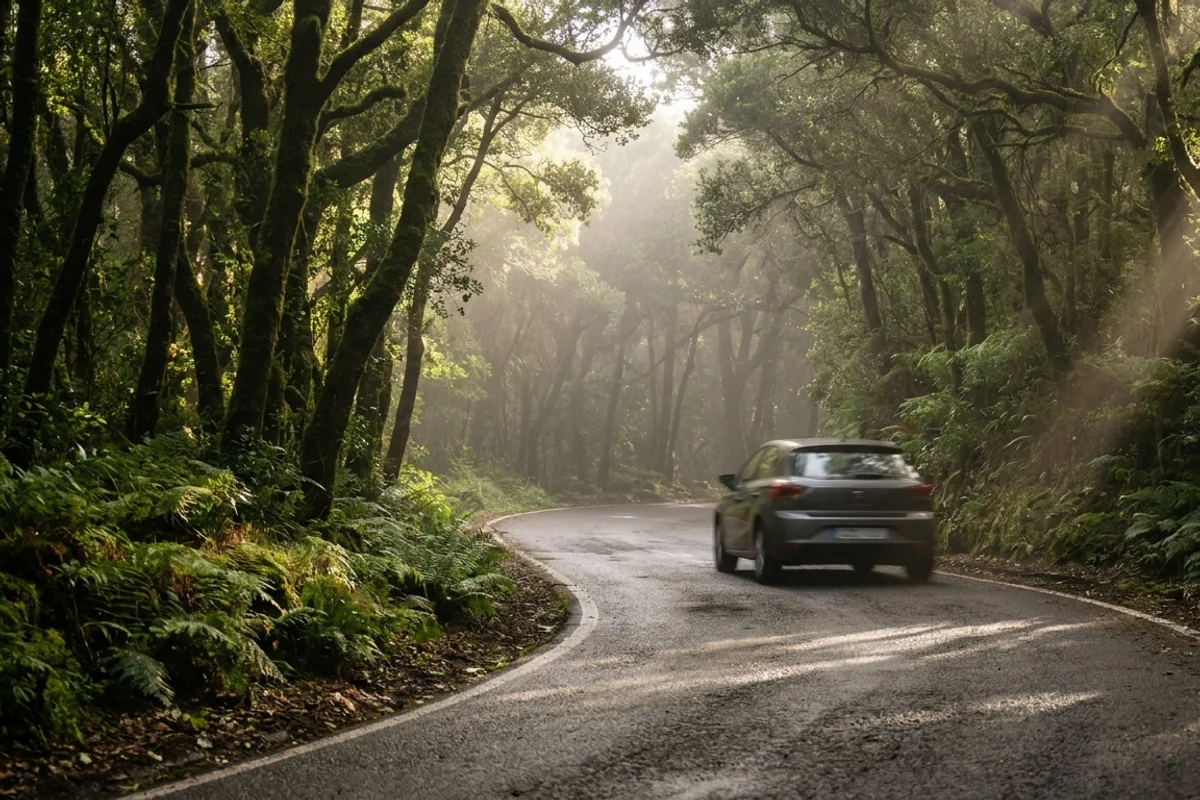
Point your hood north toward the Anaga Rural Park for a completely different climate. Take the TF-5 highway to the historic city of La Laguna, then turn onto the TF-12. This twisting road cuts straight through ancient laurel forests. The tree canopy often closes completely over the asphalt, creating a dark, green tunnel. It is a sharp visual contrast to the dry, sun-baked landscape of the south coast.
Stop at the Mirador de Cruz del Carmen. A small free parking lot sits right at the junction, though it gets very busy by midday. You can stretch your legs here on the Sendero de los Sentidos. It is a short walk that gives you a quick taste of the dense, humid forest.
Drive very slowly on the TF-12. The road is narrow and visibility is often reduced by low-hanging clouds. Local buses navigate these routes daily, and they often need to take up the middle of the road on tight corners. Give them plenty of space.
The TF-436 road to Masca is famous across the Canary Islands. It is certainly not for nervous drivers. The route begins at Santiago del Teide and drops steeply into a deep ravine, featuring relentless switchbacks and blind corners. You will be using first and second gear extensively.
Parking is extremely limited when you finally reach Masca village. Arrive before 9:00 AM or late in the afternoon to secure a spot. The village itself is tiny. The real attraction is the spectacular view down the gorge toward the ocean. A coffee at one of the small terrace cafes costs about 3 euros. The drive out toward Buenavista del Norte is just as dramatic, twisting down the cliffs to the northwestern coast.
Once you conquer the Masca descent, follow the TF-42 along the northern coast to Garachico. A massive volcanic eruption destroyed this wealthy port town in 1706. The lava flowed directly into the sea, cooling rapidly to create natural rock pools known as El Caleton.
Park your car in the large municipal lot near the football pitch. It costs roughly 2 euros to leave your vehicle there for the entire day. The rock pools are free to use. Local authorities have built concrete paths and metal ladders into the lava to help swimmers get in and out of the water. The Atlantic Ocean can be rough on the north coast. Only swim if the green or yellow flags are flying.
Back on the sunny west coast, take the TF-454 down to the resort town of Los Gigantes. The primary attraction here is the massive rock formations that give the town its name. These sheer cliffs drop 600 meters straight into the dark waters of the Atlantic Ocean. The best vantage point is the Mirador Archipenque, located right on the main approach road. Pull your car into the small parking area, grab a cold drink from the adjacent kiosk, and look out over the marina and toward the neighboring island of La Gomera.
Down in the town harbor, you can book a whale-watching boat tour. Two-hour trips cost around 25-30 euros per person in 2026. The deep channel of water between Tenerife and La Gomera is a permanent sanctuary for pilot whales and bottlenose dolphins. These boat trips operate year-round, and sightings are almost guaranteed. After your boat trip, you can drive just 10 minutes south to Playa de la Arena, a striking beach made entirely of natural black volcanic sand.
Drive past the capital city of Santa Cruz de Tenerife on the TF-11 to find the island’s most photographed beach. Playa de las Teresitas is a long crescent of golden sand imported directly from the Sahara Desert in the 1970s. A large breakwater keeps the ocean calm, making it a perfect spot for swimming.
There is a massive free parking lot right behind the beach. You rarely have trouble finding a space here, even on busy summer weekends. Before you lay your towel down, drive past the beach and take the narrow road up to the Mirador Las Teresitas. This elevated viewpoint offers the classic postcard view of the yellow sand contrasting with the blue water and the steep Anaga mountains in the background.
Planning your daily drives requires a good understanding of distances. Mountain roads take much longer to navigate than highways. Here is a quick reference guide for popular routes. These estimates assume you are starting your journey from the busy Costa Adeje area in the south.
| Destination | Primary Route | Distance from Costa Adeje | Estimated Drive Time |
|---|---|---|---|
| Mount Teide Cable Car | TF-51 to TF-21 | 45 km | 60-75 mins |
| Anaga (Cruz del Carmen) | TF-1 to TF-5 to TF-12 | 90 km | 80-95 mins |
| Masca Village | TF-1 to TF-46 to TF-436 | 35 km | 45-55 mins |
| Garachico | TF-1 to TF-82 to TF-42 | 60 km | 75-90 mins |
| Playa de las Teresitas | TF-1 to TF-11 | 85 km | 65-80 mins |
Driving around the island is generally stress-free if you follow the local rules. Speed limits are strictly enforced by fixed radar cameras and unmarked police cars. The limit on the main TF-1 highway is usually 120 km/h. This limit frequently drops to 80 km/h or 100 km/h near major junctions, so always watch the road signs. Before tackling long mountain routes, quickly check your tire pressure at a local gas station. Proper tire inflation improves handling on steep gradients.
Parking rules are indicated by colored lines painted on the road. White lines mean parking is completely free. Blue lines indicate a pay-and-display zone. You must find the nearest ticket machine and display the receipt on your dashboard. A ticket usually costs around 1 euro per hour. Yellow lines mean no parking at all. If you leave your car on a yellow line, it will be towed quickly. The municipal recovery fee is well over 100 euros, plus the cost of the parking fine.
Roundabouts can confuse visitors. The local Spanish rule is that cars in the outside lane always have priority. If you are driving in the inside lane, you must yield to cars on your right before you attempt to exit the roundabout. Do not cut across the outside lane to leave.
If your driver’s license was issued in the UK, the EU, or the EEA, you do not need an International Driving Permit. You can legally drive using your standard domestic license. Drivers visiting from the US, Canada, Australia, and other non-European countries should carry an IDP alongside their national license.
When looking for a car rental Tenerife provider, choose a compact vehicle with a reasonably powerful engine. You want a vehicle small enough to squeeze into tight street parking spots in old towns like La Orotava or Puerto de la Cruz. At the same time, you need enough engine power to comfortably climb the steep mountain gradients on the TF-21 and TF-436 without struggling.
Yes, the road infrastructure is excellent. The main highways are well-maintained, and the mountain roads have sturdy crash barriers and clear signage. The biggest hazard is usually other tourists stopping suddenly to take photographs. Always use designated viewpoints to pull over safely.
Fuel is noticeably cheaper in the Canary Islands than in mainland Spain or the UK due to a different tax regime. In 2026, a liter of unleaded gas costs roughly 1.20 to 1.35 euros. Keep an eye out for large gas stations on the TF-1 highway, as they tend to offer slightly better prices than the smaller stations up in the mountains.
No. All roads in Tenerife are completely free to use. This includes the major TF-1 and TF-5 highways that circle the island. You can drive from coast to coast without ever needing to stop at a toll booth or pay a road fee.
Exploring this diverse island at your own pace is a genuine joy. The freedom to stop at a roadside cafe in a high mountain village or chase the sunset along the western coast makes all the difference to your vacation. To get started on your itinerary, you will need a reliable vehicle waiting for you. Book your car rental in Tenerife with CARZRENT today, and we will have your keys ready the moment you land.


 Oliver Thompson

If the return time is later than the pickup time, 1 day will be added to the rental cost. Make pickup and return time the same.
 Carlos Ramirez
 Camila Fernández
 Luca Bianchi
 Thomas Schneider
 Anna Müller