El Caleton Natural Pools: A Refreshing Escape into Pristine Wilderness
 Isabella Rossi
6 min read
 Carlos Ramirez
Ready to rent a car in Tenerife?
Mount Teide dominates the Tenerife skyline from almost every angle on the island. Reaching an altitude of 3,718 metres, this dormant volcano is the highest peak in Spain. While there are plenty of bus tours available, driving to Mount Teide independently is by far the best way to experience the national park. Having your own vehicle allows you to stop at the spectacular viewpoints, avoid the crowded tour bus schedules, and stay for the incredible sunsets that paint the volcanic rock in shades of deep red and gold.
The journey from the coast to the base of the volcano involves a continuous ascent to over 2,300 metres above sea level. You need a vehicle that can handle steep gradients, tight hairpin bends, and high-altitude air.
Many visitors choose a standard economy car to save money. A small 1.0-litre engine will get you to the top, but you will spend a lot of time in first or second gear. The engine will rev loudly, and overtaking slow-moving coaches will be virtually impossible. Upgrading to a compact or mid-size vehicle with an engine size of 1.4 litres or higher provides a much smoother experience. The extra torque makes climbing the mountain effortless and keeps the drive relaxing.
Automatic transmission is highly recommended for this trip. The roads leading up to the crater involve constant gear shifting. An automatic car allows you to keep your hands on the steering wheel and your eyes on the stunning scenery. You should expect to pay around 40 to 60 euros per day for a mid-range automatic car in 2026, depending on the season.
Most travellers find it easiest to collect their vehicle as soon as they land. Booking your car at Tenerife South Airport means you can load your luggage into the boot and start your holiday immediately. The airport is conveniently located near the TF-1 motorway, giving you direct access to the southern mountain routes.
The roads inside Teide National Park are wide, smooth, and incredibly scenic. This makes the route a popular choice for driving enthusiasts. You might want to consider treating yourself from our luxury and convertible options. Driving through the pine forests with the roof down, breathing in the crisp mountain air, is a memorable way to experience the island.
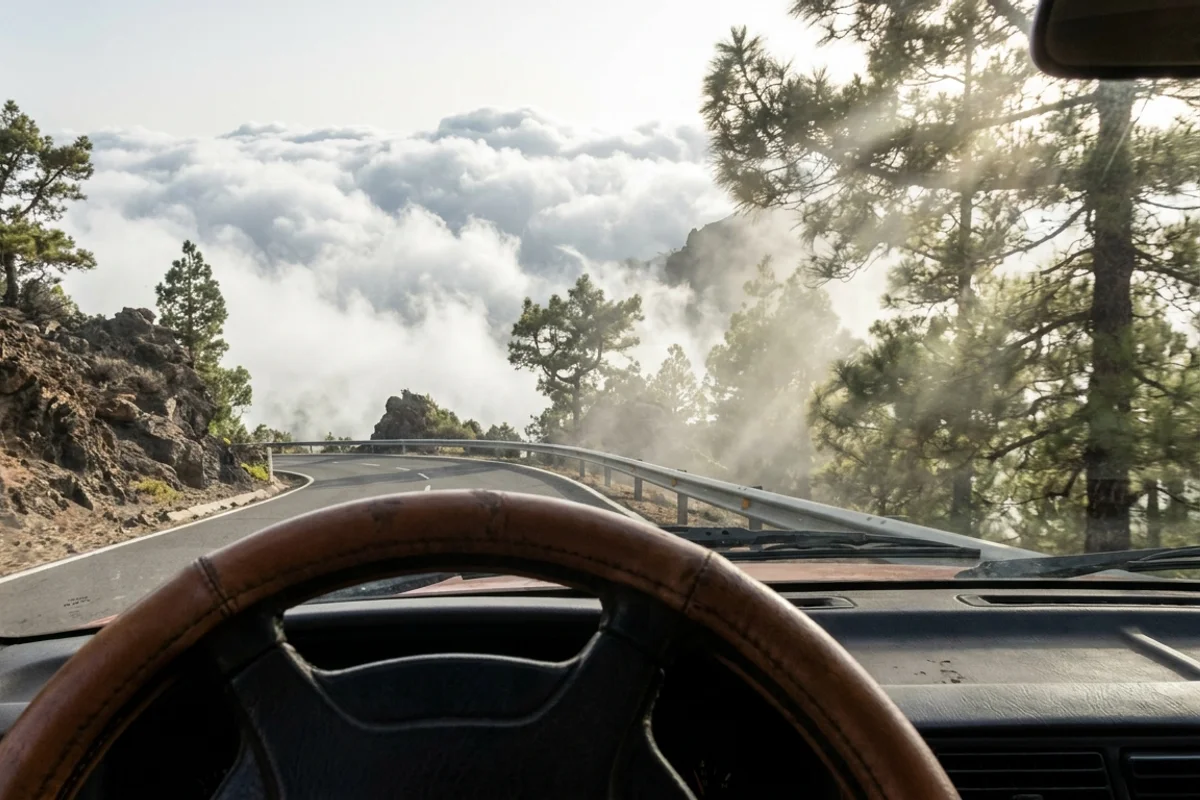
There are four primary roads leading into Teide National Park. Each route offers a completely different landscape and driving experience. All of them eventually converge near the centre of the park at the base of the volcano.
This is the most popular route for visitors staying in the southern resorts of Costa Adeje, Playa de las Americas, and Los Cristianos. You start by heading inland towards Arona and then follow the TF-51 up to Vilaflor. At 1,400 metres above sea level, Vilaflor is the highest village in Spain. It is an excellent place to stop for a coffee and stretch your legs.
Past Vilaflor, the road becomes the TF-21. The landscape shifts dramatically from dry terraces to dense Canary Island pine forests. As you climb higher, you will eventually break through the tree line and enter the surreal, rocky landscape of the caldera. The drive takes around 60 to 75 minutes from the southern coast. The corners are quite tight in the forested section, so take your time and watch out for cyclists.
If you are staying near Los Gigantes, Callao Salvaje, or Playa San Juan, the TF-38 is your best option. You access this road via the town of Chio. Many locals consider this the easiest and most enjoyable road to the volcano.
The TF-38 is noticeably wider and straighter than the other mountain roads. The tarmac was recently completely relaid, making it incredibly smooth. This route cuts directly through the dark lava fields left by the 1798 eruption of Mount Chahorra. The contrast between the jet-black rocks, the green pine trees, and the blue sky is striking. There are several lay-bys where you can pull over and walk safely among the lava boulders. The journey from the coast takes roughly 50 to 65 minutes.
Travellers staying in Puerto de la Cruz or the northern coast will use the northern section of the TF-21. This road winds its way up through the lush Orotava Valley. Because the north of Tenerife receives more rain, this side of the mountain is much greener.
This route is famous for the sea of clouds. The trade winds push moisture against the northern slopes, creating a thick layer of cloud between 1,000 and 1,500 metres. You will drive up through the misty, damp forest before suddenly bursting out into bright, clear sunshine above the clouds. The viewpoints at Mirador de la Mata and Mirador de Piedra la Rosa are essential stops. Expect the drive to take about 75 to 90 minutes.
Starting near the capital city of Santa Cruz or the historic town of La Laguna, the TF-24 is the longest but arguably the most spectacular route. Known as the Carretera de la Esperanza, this road runs along the high central ridge of the island.
You drive through dense forests of eucalyptus and pine. Because you are on a ridge, you get sweeping views of the ocean on both sides of the car. A major highlight on this route is the Mirador de la Tarta. The road here cuts deeply through the mountainside, revealing distinct, colourful layers of volcanic ash that look like a slice of cake. Driving this route takes between 80 and 100 minutes.
| Route Name | Starting Region | Main Road | Approximate Drive Time | Key Feature |
|---|---|---|---|---|
| Southern Route | Costa Adeje / Los Cristianos | TF-51 then TF-21 | 60-75 mins | Passes through Vilaflor, Spain’s highest village |
| Western Route | Los Gigantes / Chio | TF-38 | 50-65 mins | Widest roads, smooth tarmac, massive black lava fields |
| Northern Route | Puerto de la Cruz | TF-21 (North) | 75-90 mins | Lush green forests and the famous sea of clouds |
| Northeastern Route | Santa Cruz / La Laguna | TF-24 | 80-100 mins | Spectacular ridge driving with ocean views on both sides |
Finding a parking space is the biggest challenge when visiting Mount Teide by car. The national park receives millions of visitors a year, and parking infrastructure is strictly limited to protect the environment.
If you plan to take the cable car to the upper station, you will aim for the Teleferico car park at kilometre 43 on the TF-21. This car park is free, but it is relatively small. During the peak seasons of July, August, and the winter holidays, this lot often fills up completely by 10:00 AM. If you arrive later and find it full, you are not allowed to park on the hard shoulder of the main road. The police patrol the area frequently and will issue fines of up to 200 euros for illegal parking.
A few kilometres south of the cable car is the Roques de Garcia viewpoint and the Parador hotel. This area has a larger car park. It is the starting point for several excellent hiking trails around the famous rock formations. This lot also gets incredibly busy by midday. People are constantly coming and going, so if you wait patiently for a few minutes, a space usually opens up.
To avoid the parking stress entirely, plan your arrival for early in the morning before 09:30 AM, or late in the afternoon after 15:30 PM. The late afternoon is particularly peaceful. The large tour buses leave the park by 15:00 PM, leaving the roads and car parks practically empty.
The weather at the summit of Mount Teide is drastically different from the coastal resorts. It is common to leave your hotel in 28-degree heat and step out of your car at the cable car station to find the temperature has dropped to 12 degrees. In the winter months between December and March, the temperature at the base often falls below freezing, and snow is common.
Always pack layers in your car boot. A warm jumper and a windproof jacket are essential, even in August. The sun at 2,300 metres is incredibly strong due to the thin atmosphere. Sunglasses and high-factor sun cream are necessary to prevent severe sunburn.
Sunset is a magical time to drive through the park. As the sun drops, it casts a massive triangular shadow of the volcano out across the ocean. After dark, Teide National Park becomes one of the best places in the world for stargazing. The local government strictly controls light pollution, and the high altitude keeps you above the cloud layer. There are several designated viewpoints, such as the Mirador de los Poleos on the TF-38, where you can park safely in the dark to observe the Milky Way.
Driving in a high-altitude national park requires some basic preparation. There are absolutely no petrol stations inside Teide National Park. The last places to buy fuel are the towns on the lower slopes, such as Vilaflor in the south, Chio in the west, or La Esperanza in the northeast. Petrol currently costs around 1.30 to 1.45 euros per litre in Tenerife. Make sure you have at least a half tank of fuel before you begin the final ascent.
You will share the mountain roads with hundreds of cyclists. Tenerife is a major winter training destination for professional cycling teams. The gradients are long and challenging. When you approach a cyclist, slow down and wait for a safe, clear stretch of road before overtaking. The law in Spain requires you to leave a minimum gap of 1.5 metres between your car and the cyclist when passing.
When it is time to drive back down to the coast, you need to manage your brakes. Relying entirely on your brake pedal for a 40-minute descent will cause the brake pads to overheat. You might experience brake fade, where the car struggles to stop. You must use engine braking. If you are driving a manual car, drop down into second or third gear and let the engine control your speed. If you have an automatic car, switch the gear lever into manual mode or use the steering wheel paddles to select a lower gear.
The drive is not dangerous. The primary roads leading into the national park are fully paved, wide enough for two coaches to pass, and maintained to a very high standard. There are crash barriers on the steepest sections. Drivers who are nervous about mountain roads usually find the western TF-38 route the least intimidating.
You do not need a 4×4 vehicle. All the public roads and official car parks in the national park are surfaced with smooth tarmac. Off-roading is strictly prohibited in Tenerife to protect the fragile volcanic ecosystem. A standard front-wheel-drive car is perfectly adequate.
All roads leading to Mount Teide, and indeed all motorways in Tenerife, are completely free to use. You will not encounter any toll booths during your holiday.
During the winter, heavy snowfall occasionally blocks the roads near the summit. The local authorities will close the access gates at the lower altitudes for safety. Road closures are announced quickly on local news websites and the official Tenerife road information channels. If the roads are closed, do not attempt to bypass the barriers.
Facilities are very limited. There is a small cafeteria at the cable car base station and a restaurant at the Parador hotel. Prices here reflect the remote location. It is highly recommended to buy water, snacks, and sandwiches from a supermarket on the coast before you start your drive.
Having your own vehicle transforms a simple sightseeing trip into a true adventure. You control the pace, the route, and the playlist. Ready to explore the volcano? Find the perfect car hire Tenerife offers with CARZRENT and start planning your ascent today.
Car rental at Tenerife South Airport (TFS) → · SUV hire in Tenerife → · Convertible car hire in Tenerife →
Planning your Tenerife trip?
 Isabella Rossi


 Mia Andersen


 Sophie Dubois
The minimum chargeable car rental period is 24 hours. If you specify a return time later than the time you received the car, 1 rental day is added.
 Luca Bianchi
 James O’Connor
 Thomas Schneider