The Best Photographic Spots in the Canary Islands
 James O’Connor
5 min read
 Camila Fernández

Tenerife's south coast has the warmest, driest winter in the Canaries, with average highs of about 22 °C at Tenerife South Airport. With a car from Playa de las Américas you can swim behind the breakwaters at El Camisón, spend an afternoon on the fine sand of Playa del Duque, explore the quieter coves along the TF-1 and take the ferry from Los Cristianos for a day on the black sand of Valle Gran Rey.
From December to February, the coast of every Canary Island stays warm enough for the beach, with average highs of about 21–22 °C. The islands are not equal, though: the south of Tenerife gets less than half as many rainy days as La Palma’s airport, Lanzarote gets the most sunshine, El Hierro has the mildest nights, and the winter swell decides which beaches are calm on a given day.
This guide compares the winter climate of all seven islands using long-term averages from AEMET, the Spanish weather service, then picks two or three sheltered beaches on each island, with notes on wind, swell, safety and the drive there. For month-by-month weather on the largest island, see our guide to Tenerife weather by month.
In short
The table shows AEMET’s 1981–2010 averages for December to February at each island’s airport. Six of the seven stations are below 70 m, so they show the coast, not the cooler hills.
| Island (weather station) | Average high | Average low | Days of rain, Dec–Feb | Sunshine a day |
|---|---|---|---|---|
| Tenerife (Tenerife South Airport, 64 m) | 22.2 °C | 15.6 °C | 7.5 | 6.5 hours |
| Gran Canaria (Gran Canaria Airport, 24 m) | 21.4 °C | 15.4 °C | 10.6 | 6.1 hours |
| Lanzarote (Lanzarote Airport, 14 m) | 21.3 °C | 14.6 °C | 9.7 | 6.6 hours |
| Fuerteventura (Fuerteventura Airport, 25 m) | 21.2 °C | 15.1 °C | 8.1 | 6.3 hours |
| La Palma (La Palma Airport, 33 m) | 21.0 °C | 15.8 °C | 17.5 | 4.7 hours |
| La Gomera (La Gomera Airport, 219 m) | 20.9 °C | 15.0 °C | 9.6 | Not measured |
| El Hierro (El Hierro Airport, 32 m) | 21.3 °C | 16.9 °C | 10.4 | 4.9 hours |
A day of rain means at least 1 mm. AEMET publishes no official averages for La Gomera, so that row uses the airport’s 1991–2020 records from AEMET’s open data service.
There is no official sea temperature average per island. The ESTOC ocean station north of the islands measured about 20 °C in early 2024 and 19.7 °C in early 2025, both warmer than usual; in colder winters the sea used to drop closer to 18 °C. AEMET’s beach forecast gives the expected water temperature for many beaches: on 17 November 2026 it showed 23 °C at Maspalomas.
In Playa de las Américas, the calmest water is at El Camisón, sheltered from the waves by a row of breakwaters. Next door, Playa de Troya has a surfing area, so keep to the swimming zone. Las Vistas, 850 m of golden sand towards Los Cristianos, has calm water and views of the La Gomera ferry. With car rental in Playa de las Américas, every beach on this coast is a short drive away.
Los Cristianos beach, 345 m long beside the port, has calm water that suits children; see our list of things to do in Los Cristianos. Farther along the coast, Playa del Duque in Costa Adeje is 390 m of fine sand with calm water, linked by a promenade to at least eight other beaches. Our Costa Adeje guide has the details, and car rental in Costa Adeje lets you reach the quieter coves beyond the resorts.
From Tenerife South Airport, the TF-1 motorway reaches Los Cristianos and Playa de las Américas in about 20 km and Playa del Duque in about 24 km. For wilder beaches, see our guide to the best beaches in south Tenerife you can only reach by car.
The resorts of Gran Canaria are in the south and southwest, along the GC-1 motorway. Maspalomas is almost 3 km of golden sand with little swell, between the 400-hectare dunes and a lighthouse that has worked since 1890. Amadores is a man-made bay of pale sand, 488 m long, with calm water inside its breakwaters. At the end of the motorway, the 209 m beach at Puerto de Mogán has calm water, and Spain’s official tourism site lists lifeguards and a Red Cross post there.
From the airport it is about 35 km on the GC-1 to Maspalomas and 55 km to Puerto de Mogán; for Amadores, take the GC-500 coast road, about 50 km in all. Car rental in Gran Canaria starts at the airport.

Lanzarote has the most sunshine but the coolest nights. In Playa Blanca, Playa Dorada is 350 m of white sand enclosed by rocks in the shape of a shell, which keeps the water calm, and Playa Flamingo also has calm water and lifeguards. East of the town, Playa de Papagayo is a 120 m cove of white sand between two cliffs in the Los Ajaches natural monument.
Playa Blanca is about 30 km from the airport on the LZ-2. Papagayo is reached by a dirt track; drivers who are not island residents pay to enter, and in February 2026 Yaiza council regraded about 7 km of the tracks after rain damage. Rent a car in Lanzarote at the airport to see both.
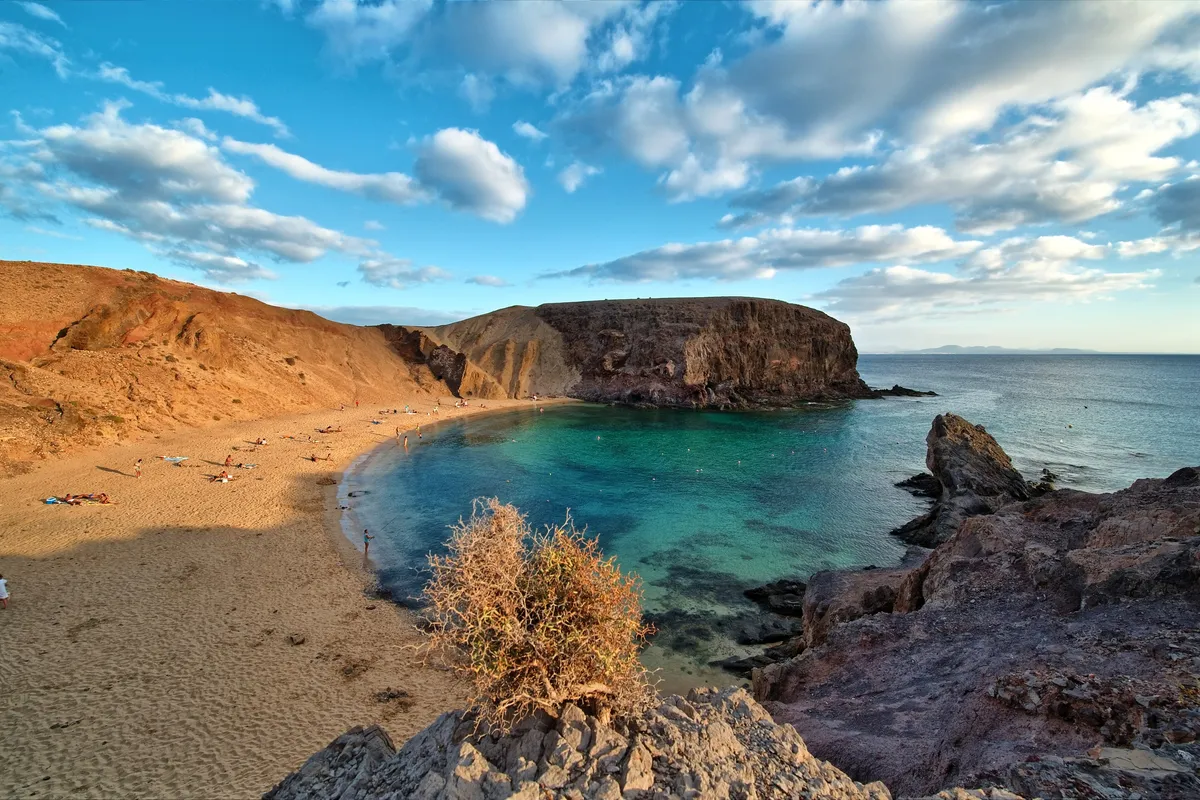
The beaches of the Jandía peninsula are long and pale, and Spain’s official beach data class both El Matorral at Morro Jable and Sotavento as windy, with calm water. El Matorral runs for more than 4 km of fine white sand to Morro Jable, with a naturist section. Sotavento, about 1.1 km of golden sand, is a surfing and windsurfing beach, and a shallow lagoon forms behind a sandbar at certain tides. Next to it, Costa Calma has lifeguards and small family beaches at its northern end.
From the airport, follow the FV-2 south: Costa Calma and Sotavento are about 70 km away, Morro Jable about 90 km. Car rental in Fuerteventura makes it easy to switch beaches when the wind picks up.

La Palma’s airport, on the east side, has the most rain and least sun in the table; Puerto Naos and Tazacorte are on the west coast. Puerto Naos is 400 m of dark sand and gravel with moderate swell. It was in an exclusion zone from September 2021 to July 2024 because of volcanic gases, summer 2025 was its first almost normal season, and in July 2026 the Cabildo also allowed swimming at Playa Chica after carbon dioxide levels fell. Gas sensors are still in place, so follow any signs.
Puerto de Tazacorte has 200 m of dark sand and gravel, split by the mouth of the Barranco de las Angustias, with a pool on the beach. Both are about 38–39 km from the airport via the LP-3 to Los Llanos de Aridane, and a new road over the 2021 lava has linked them since May 2023. Car rental on La Palma is available at the airport.
Valle Gran Rey, in the west of the island, has the long dark-sand beach of La Playa, with calm water, the small beach at Vueltas by the harbor, and Charco del Conde, a natural pool the Canary Islands tourism board rates as the island’s most family-friendly. Playa del Inglés, a nudist beach, has moderate swell and calls for caution.
The ferry from Los Cristianos to San Sebastián de La Gomera takes about 50 minutes. From the port, the GM-2 and GM-1 cross the island to the valley, about 51 km, so allow at least an hour; La Gomera Airport is about 45 km away. You can also pick up a car on La Gomera instead of bringing one across.

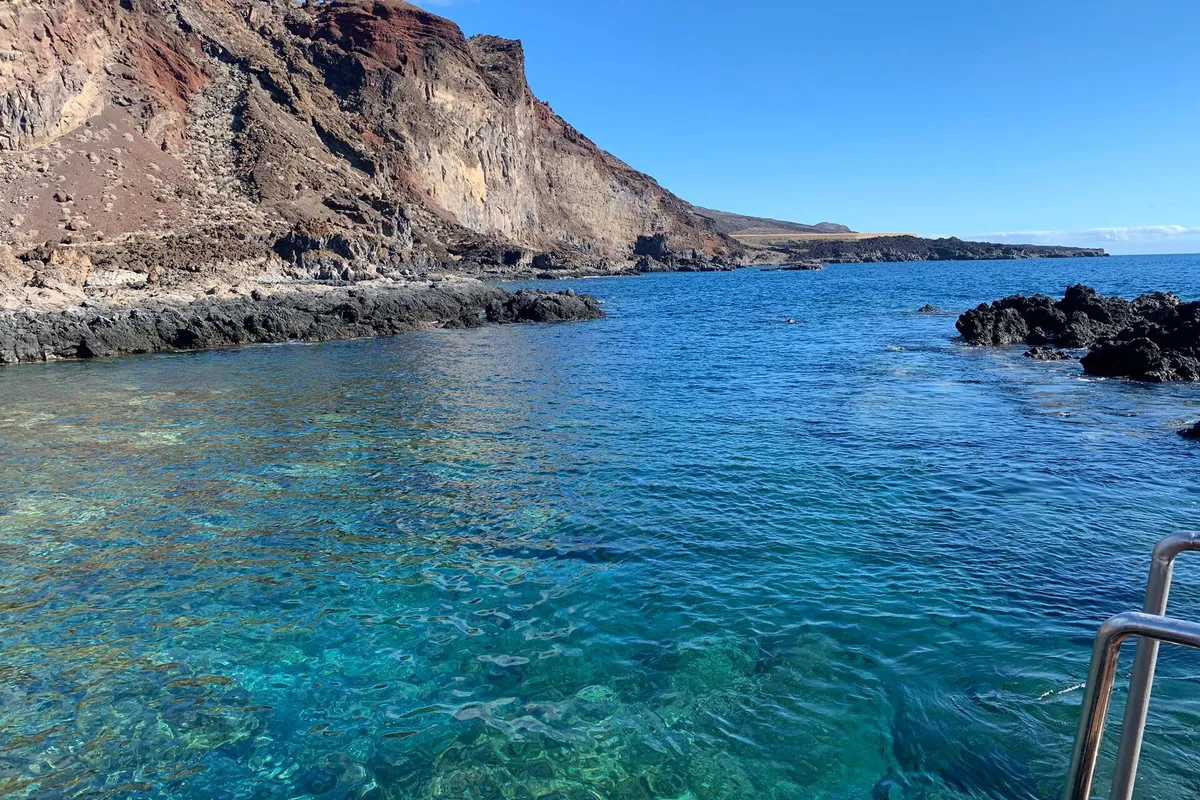
In the far south of El Hierro, the village beach at La Restinga is 50 m of black volcanic sand with calm water and little swell, rated low risk in every season by the islands’ tourism board, with diving centers at the pier. Tacorón, signed off the HI-4 just before La Restinga, is a small cove with natural pools, barbecue areas and toilets, and its clear water invites a swim at any time of year. From El Hierro Airport it is about 41 km to La Restinga via Valverde and the HI-4 through El Pinar; rent a car on El Hierro to see both in one day.
The Canary Islands government uses three flags: red means swimming is prohibited, yellow means caution and green means conditions are good. If a current pulls you out, do not swim against it: let it carry you until it weakens, then move away from the breaking waves, and call 112 if you see someone in trouble. North coast beaches are more dangerous because of currents.
Winter storms change that quickly. On 24 January 2026, AEMET warned of dangerous seas on coasts open to the west, north and northeast, with waves of 5–6 m and some of 7–8 m, and La Laguna closed its whole coast to swimming. On days like that, stick to sheltered south-facing beaches. Lifeguard cover varies by town and season, and not every beach has one, so check for the flag and the lifeguard post when you arrive. Our guide to natural pools in Tenerife lists which pools close in a swell and where to watch the waves safely.
The south of Tenerife has the highest average highs, 22.2 °C at Tenerife South Airport from December to February, and the fewest rainy days. The differences between islands are just over one degree.
Yes. As an estimate, the sea is about 18–20 °C in January and February, and sheltered beaches such as Los Cristianos, Amadores and Puerto de Mogán have calm water.
The south and southwest. On Tenerife the north is cloudier and wetter, and the Canary Islands government warns that north coast beaches are more dangerous because of currents.
Partly. It has reopened in stages since the 2021 eruption, and in July 2026 swimming was also allowed at Playa Chica. Gas monitoring continues, so check local notices.
Cover photo: Playa de Las Vistas, between Los Cristianos and Playa de las Américas, Tenerife. Photo: Tuxyso, CC BY-SA 4.0, via Wikimedia Commons


 Carlos Ramirez

 Sophie Dubois


If the return time is later than the pickup time, 1 day will be added to the rental cost. Make pickup and return time the same.
 Anna Müller
 Luca Bianchi
 Mia Andersen