BMW M5 Competition Tenerife Driving Review
 Sophie Dubois
7 min read
 Isabella Rossi
Ready to rent a car in Tenerife?
Hidden away in the Teno Mountains on the western edge of the island, you will find one of the most spectacular destinations in the Canary Islands. The area is known as masca tenerife to most visitors, though locals simply call it Masca. This tiny hamlet sits precariously on a ridge surrounded by towering peaks and deep ravines. Reaching it requires a head for heights and a reliable vehicle. The journey is an attraction in its own right.
Most travelers start their ascent from the town of Santiago del Teide. You leave the main TF-82 road and turn onto the TF-436. This is where the real driving experience begins. The asphalt is smooth, but the road is famously narrow. It twists and turns up the mountainside before cresting at the Mirador de Cherfe. You should absolutely pull over here. The viewpoint offers a panoramic look across the Teno Rural Park. On a clear day, you can see the neighboring island of La Gomera across the Atlantic.
From the viewpoint, the road drops sharply into the valley. You will encounter several tight hairpin bends. Driving this route in a manual car means sitting in second gear for long stretches. Automatic vehicles handle the steep gradients effortlessly. If you are looking for a car rental Tenerife, you might want to consider a compact SUV with a bit of extra ground clearance and engine power. The extra torque makes the climb much more comfortable. For those who want to feel the mountain breeze, renting a luxury car or a convertible adds a completely different dimension to the trip. You can see what is currently available under convertible rental in Tenerife.
Driving to Masca from the north via Buenavista del Norte is a completely different experience. You travel through the lush, green landscapes of the Isla Baja region before climbing into the mountains. This northern section of the TF-436 is arguably more challenging than the southern route. The vegetation is thicker, the road is narrower and the blind corners require constant attention. Sounding your horn lightly before a sharp, blind bend is a common and recommended practice here.
When selecting your vehicle, consider opting for comprehensive insurance. The mountain roads are narrow, and minor scrapes against stone walls or stray branches are not uncommon. Keep your speed low and always yield to uphill traffic if the road narrows to a single lane.
The village itself is split into several small clusters of houses. La Piedra, El Turron, La Montaneta and El Faldal make up the settlement. The total population rarely creeps above 90 residents. Traditional Canarian architecture dominates the landscape. The houses feature thick stone walls, wooden balconies and terracotta roof tiles. They cling to the rock face in a way that defies gravity.
Local legend suggests that Masca was once a hideout for pirates. The village is hidden from the sea, making it the perfect spot to watch for passing trade ships while remaining completely unseen. Historians debate the accuracy of these pirate tales, but the rugged isolation of the village makes the stories easy to believe. Until the 1990s, Masca was not even connected by a paved road. The only way in or out was by donkey or on foot.
Parking is notoriously difficult. The main parking lot holds around 40 vehicles. It fills up by 10:00 am most mornings. If you arrive later, you will likely have to park further up the road and walk down. A smart strategy is to arrive by 8:30 am. You get your pick of parking spots and can enjoy a quiet morning coffee before the main crowds arrive.
Stop by one of the small cafes near the main square. Order a barraquito. This layered local coffee contains espresso, condensed milk, Licor 43, frothed milk, a dash of cinnamon and a slice of lemon peel. It provides an excellent sugar and caffeine hit before you start walking. You can also buy jars of local palm honey and cactus jam from small vendor stalls. These make excellent, lightweight souvenirs.
The Barranco de Masca is the main draw for active travelers. This deep gorge cuts a dramatic path from the village straight down to the ocean. The trail reopened a few years ago with strict new safety regulations, and the rules for 2026 are heavily enforced. You cannot simply turn up and walk down.
You must secure a permit in advance through the official Caminos de Tenerife website. Permits cost 29 euros for adult non-residents. The trail is only open from Friday to Sunday, plus public holidays. Entry times are strictly controlled between 8:30 am and 11:00 am. Hiking permits for the gorge are released on the official website a month or two in advance. They sell out incredibly fast, especially for weekend slots. You need to treat the booking process like buying tickets for a popular concert. Be online the moment a new batch of dates goes live.
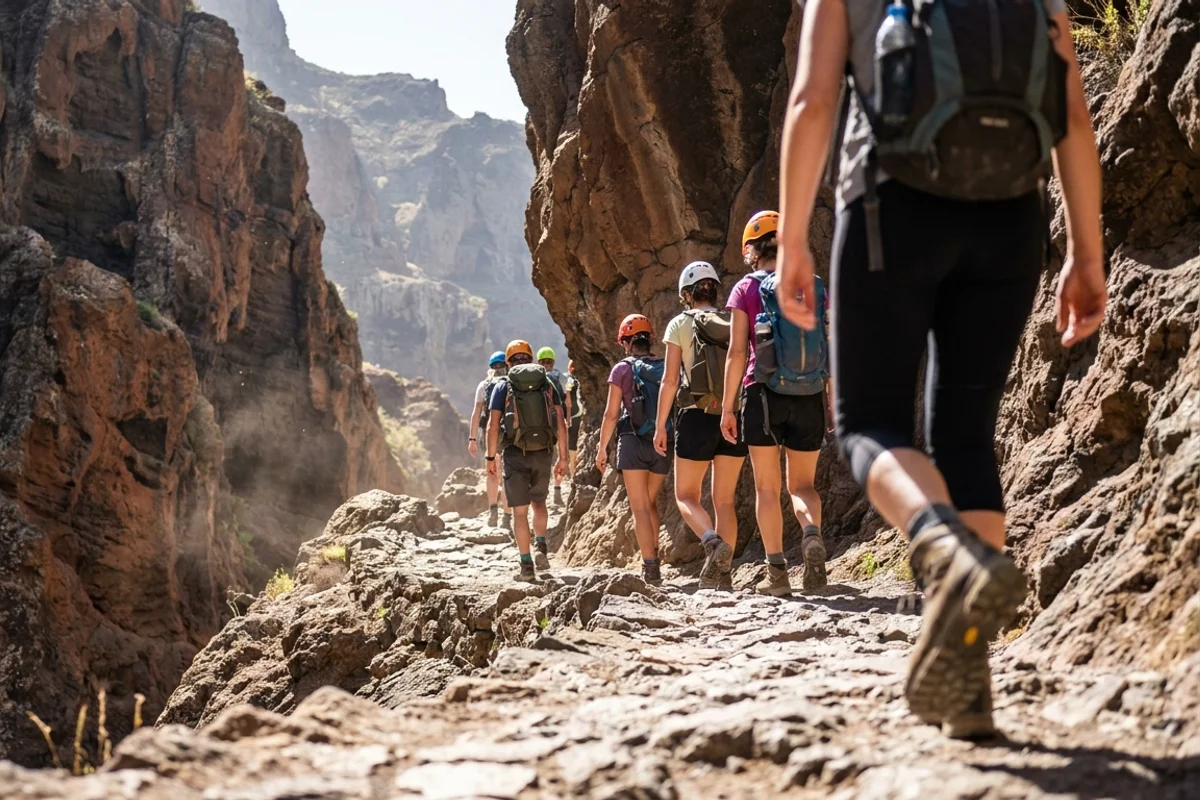
The hike is physically demanding. You cover just under five kilometers, but the elevation drop is a punishing 600 meters. The terrain consists of loose rocks, large boulders and slippery stream crossings. The park rangers at the trailhead will inspect your footwear. If you are wearing flat-soled trainers, sandals or casual shoes, they will refuse entry. You need proper hiking boots with deep treads.
You must bring the following items to be allowed on the trail:
The descent takes roughly three hours. The walls of the ravine rise hundreds of meters on either side. The rock formations show millions of years of volcanic activity, with distinct layers of basalt and ash. Endemic plants like the cardon cactus and the blue tajinaste grow out of seemingly bare rock. It is incredibly quiet down in the gorge, save for the sound of running water and the occasional call of a kestrel.
At the end of the trail, you reach Masca beach. It is a small cove of black volcanic sand and pebbles. Swimming is often prohibited due to strong currents, but sitting by the water is a huge relief after the long hike.
Getting back requires planning. In the past, hikers would walk down and take a water taxi to the nearby resort of Los Gigantes. The pier at Masca beach was closed for extensive repairs for several years. As of 2026, the new pier is operational, but water taxis only run when sea conditions are safe. You must book your boat ticket at the same time you book your hiking permit. The boat ride takes 15 minutes and offers incredible views of the Acantilados de Los Gigantes. These massive cliffs rise up to 600 meters straight out of the ocean.
If the boats are not running, you have to walk back up the gorge. The ascent is gruelling and takes around four hours. You need exceptional fitness to complete the round trip.
Let us look at the driving distances and times from popular tourist hubs to the village. The times reflect normal daytime traffic in 2026. Most people set off from the southern resorts, so car rental in Costa Adeje or car rental in Playa de las Americas puts you at the start of the TF-436 in well under an hour.
| Starting Location | Main Route | Distance | Estimated Driving Time |
|---|---|---|---|
| Costa Adeje | TF-1 to TF-82, then TF-436 | 40 km | 50 minutes |
| Los Cristianos | TF-1 to TF-82, then TF-436 | 45 km | 55 minutes |
| Puerto de la Cruz | TF-5 to TF-82, then TF-436 | 55 km | 1 hour 15 minutes |
| Buenavista del Norte | TF-436 (Northern approach) | 15 km | 35 minutes |
Most visitors fly into the south of the island. Collecting your vehicle directly at Tenerife South Airport is the most efficient way to start your vacation. The rental desks are located right in the main arrivals hall. A standard economy car costs around 30-45 euros per day in 2026, depending on the season. If you plan to drive the TF-436 to Masca, make sure you are comfortable with the dimensions of your rental car.
For that road in particular, SUV rental in Tenerife gives you the ground clearance and the torque the climb rewards.
The drive from the airport to Santiago del Teide takes about 40 minutes via the TF-1 highway. The road is fast, modern and well-maintained. The contrast between the multi-lane highway and the ancient, winding mountain roads of the Teno Rural Park is striking.
The road is steep and features sharp bends, but it has good crash barriers and a smooth surface. It is not dangerous if you drive slowly and respect the right of way. Always yield to the large public buses on tight corners.
Yes. You must book a permit online well in advance. The trail is heavily regulated, and rangers check tickets at the entrance. You will be turned away without a valid reservation.
Authorized water taxis operate from the beach to Los Gigantes, provided the sea is calm. You must book this service when you buy your hiking permit. If the sea is rough, boats will not dock, and you will have to hike back up.
There is a small public parking lot at the entrance to the village. Space is extremely limited. Arrive before 9:00 am to secure a spot, or take the public bus (line 355) from Santiago del Teide to avoid parking issues entirely.
Spring and fall offer the best conditions. The weather is warm but not excessively hot, making the hike much more comfortable. Winter can bring rain, which often leads to the gorge trail being closed for safety reasons.
Having your own transport gives you the freedom to arrive early and beat the crowds at the viewpoints. Check out our main page for car rental Tenerife to compare vehicles, view live 2026 pricing, and secure your booking for your upcoming island adventure.


 James O’Connor
 Carlos Ramirez
 James O’Connor

 Luca Bianchi
 Carlos Ramirez
If the return time is later than the pickup time, 1 day will be added to the rental cost. Make pickup and return time the same.
 Anna Müller