The Best Beaches in South Tenerife You Can Only Reach by Car
 Anna Müller
10 min read
 James O’Connor
Ready to rent a car in Tenerife?
Arriving in the Canary Islands should feel immediately relaxing. You step off the plane, feel the warm Atlantic breeze, and just want to get straight to your accommodation in Costa Adeje, Puerto de la Cruz, or El Medano. The absolute last thing you need is a stressful surprise at the rental desk. A common anxiety for travellers is the payment process. Traditionally, hiring a vehicle meant handing over a credit card to block a massive security deposit. This hold can easily range from 800 to 1500 euros. Blocking that much cash is frustrating. It eats directly into your spending money for tapas, boat trips, and holiday souvenirs.
Fortunately, the local transport industry has modernised. You can easily bypass this financial block. If you want to rent car tenerife no deposit no credit card, you have excellent options that let you use a standard debit card. This keeps your holiday budget entirely in your own hands.
To understand how to avoid a deposit, you first need to know why companies ask for one. Standard rental agreements come with a basic Collision Damage Waiver. This basic cover includes an excess. The excess is the maximum amount you are liable to pay if the vehicle is damaged or stolen. To guarantee you can actually pay this excess if you scrape a bumper against a stone wall in Garachico, the desk agent blocks funds on your credit card.
The secret to removing the deposit is removing the excess. You achieve this by purchasing premium insurance directly from the supplier. This is often called Super Collision Damage Waiver or Premium Cover. Once your liability drops to zero, the supplier no longer requires a financial guarantee for vehicle damage. They will happily accept a standard debit card for the cost of the rental and the insurance package. You walk away with the keys, and your bank account remains fully accessible.
This premium cover also provides immense peace of mind. Driving in a foreign country can be intimidating. Narrow mountain roads and unfamiliar parking garages increase the risk of minor scratches. With zero excess insurance, you do not have to worry about a minor scuff ruining your trip. You simply hand the keys back at the end of your stay and catch your flight.
Leaving your credit card at home means you must bring a valid debit card. Visa Debit and Debit Mastercard are universally accepted across the Canary Islands. The physical plastic card must have the main driver’s name printed on it. Virtual cards on Apple Pay, Google Wallet, or Samsung Pay are frequently rejected by the physical payment terminals at the desk. Always pack the actual card.
Modern challenger banks and prepaid cards like Monzo, Revolut, or Starling work perfectly well for paying the upfront rental fee. The only requirement is that they are backed by the Visa or Mastercard network. Cash is almost never accepted for the vehicle itself due to strict corporate security policies. You might occasionally be allowed to use euros to pay for a child seat or a GPS unit at the counter, but the main contract requires a card.
Most international visitors land at Tenerife South Airport, officially named Reina Sofia. The arrivals hall gets exceptionally busy, especially on Friday and Saturday afternoons when multiple flights from the UK and Germany land simultaneously. Having a vehicle booked in advance saves you from haggling with walk-up agents. The process is much smoother when you arrange to pick up your vehicle at Tenerife South Airport (TFS) ahead of time.
Because you have opted for a zero-excess package, the handover is incredibly fast. You show your passport, your driving licence, and your debit card. You sign the digital contract. The agent hands you the keys. There is no lengthy vehicle inspection required. You do not have to walk around the car in the dark, photographing every existing scratch on the doors and bumpers to protect yourself.
The airport parking structure is located just a short walk across the road from the terminal building. You load your luggage, start the engine, and merge straight onto the TF-1 motorway within five minutes. This motorway is the main artery of the island, connecting the airport directly to the major southern resorts in one direction, and the capital city of Santa Cruz in the other.
Budgeting for your trip requires accurate, up-to-date figures. The post-pandemic fleet shortages have largely stabilised. However, 2026 prices still reflect the incredibly strong seasonal demand of the Canary Islands. Winter is actually the peak season here. Travellers from northern Europe flock to the guaranteed sunshine between November and March. Summer is slightly cheaper, though August sees a distinct spike from mainland Spanish tourists taking their annual leave.
Below is a realistic breakdown of average daily rates you can expect when booking a car rental Tenerife with full insurance included. These figures eliminate the need for a credit card deposit entirely.
| Vehicle Class | Example Model | Low Season (May-Jun 2026) Daily Rate | High Season (Dec-Feb 2026) Daily Rate | Deposit Required |
|---|---|---|---|---|
| Economy | Volkswagen Polo or similar | 35 EUR | 55 EUR | 0 EUR |
| Compact | Seat Leon or similar | 42 EUR | 65 EUR | 0 EUR |
| Small SUV | Nissan Juke or similar | 50 EUR | 75 EUR | 0 EUR |
| People Carrier (7 Seats) | Volkswagen Caddy or similar | 75 EUR | 120 EUR | 0 EUR |
Tenerife is essentially a massive volcano rising dramatically out of the Atlantic Ocean. The coastal tourist areas are relatively flat, but the interior is incredibly steep. Your choice of vehicle should reflect the type of driving you plan to do.
If you intend to spend your entire holiday driving short distances between your hotel in Los Cristianos and the nearby beaches of Costa Adeje, a small economy car is perfectly fine. Vehicles like a Fiat 500 or Hyundai i10 are easy to park in busy resort towns. They use very little fuel and navigate narrow one-way streets with ease.
Exploring the island properly requires something with a bit more engine power. The drive up to Teide National Park via the TF-21 or TF-38 involves long, continuous climbs that reach an altitude of over 2000 metres. An economy car with a basic 1.0-litre engine will struggle on these gradients. You will find yourself stuck in second gear while local traffic builds up impatiently behind you. Upgrading to a compact car or a small SUV makes the ascent much more comfortable and safer.
For those planning a special trip, perhaps a honeymoon or a significant birthday, driving a high-end vehicle along the coastal roads is a fantastic experience. You can find premium options that still offer flexible payment terms without massive credit card holds. Browse our selection of luxury vehicles to cruise the southern coast in absolute style, feeling the ocean breeze with the roof down.
Driving in the Canary Islands is generally straightforward for confident drivers. The main roads are exceptionally well maintained and clearly signposted. The TF-1 motorway is the longest road on the island. It connects the capital, Santa Cruz, in the northeast to the southern resorts, wrapping around the coast to end at Santiago del Teide in the west. The TF-5 is the northern equivalent, linking Santa Cruz to the historic city of Puerto de la Cruz and the wine region of Icod de los Vinos. These motorways are toll-free.
Mountain roads demand significantly more attention and respect. The Anaga Rural Park in the extreme northeast features the TF-12. This is a spectacular but narrow road that winds heavily through ancient laurel forests. It is full of blind corners and sudden drops. The local driving etiquette dictates that you should sound your horn lightly before a sharp, blind bend to warn any oncoming traffic. Always give way to public Titsa buses and heavier vehicles on steep gradients, as they need momentum to climb.
Another notorious route is the TF-436 down to the village of Masca. This road is famously serpentine, clinging to the side of deep ravines. It is not recommended for nervous drivers. If you do tackle it, rely on your lower gears to control your descent rather than riding your brakes, which can overheat quickly on such a long downhill stretch.
Finding a parking space can be a frustrating challenge in older towns and busy tourist hotspots. In major urban centres like Santa Cruz and San Cristobal de La Laguna, street parking is highly competitive. Your best strategy is to head straight for a paid underground car park. The hourly rates are very reasonable, typically around 1.50 to 2.00 euros per hour. Paying a few euros is much better than driving in circles for forty minutes looking for a free space.
When you do park on the street, pay close attention to the coloured lines painted on the road edge. Yellow lines mean absolutely no parking at any time. If you park on a yellow line, your car will likely be towed away by the local municipal police. Blue lines indicate a pay-and-display zone. You must find the nearest ticket machine, pay for your intended time, and display the ticket clearly on your dashboard. White lines indicate free parking, but these spaces are rare in commercial districts.
Tenerife is famous for its microclimates. You can experience three different weather systems in a single hour of driving. The south coast is almost permanently sunny and dry. As you drive north on the TF-1 towards Santa Cruz, you will often see a thick bank of clouds hugging the mountains.
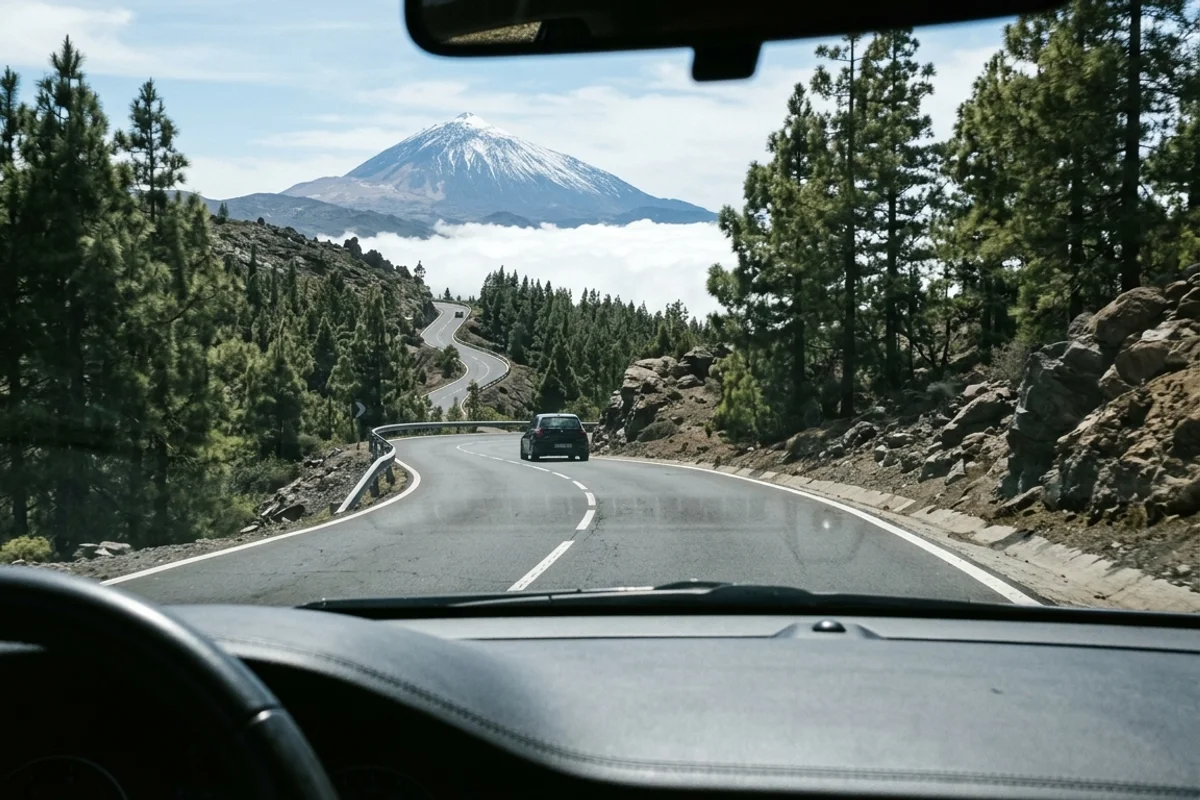
The northern side of the island receives much more rainfall, which makes the landscape beautifully green but makes the roads slippery. When driving up the TF-24 towards the Mount Teide observatory, you will often pass directly through the cloud layer. Visibility can drop to just a few metres. You must use your fog lights and reduce your speed drastically. Once you break through the cloud inversion at around 1500 metres of altitude, you will suddenly be back in blinding, brilliant sunshine. Keep a pair of sunglasses easily accessible in the centre console at all times.
Maestro and Visa Electron cards are notoriously unreliable at international rental desks. The payment terminals often decline them. It is strongly recommended to travel with a standard Visa Debit or Debit Mastercard to ensure your payment goes through smoothly and you get your keys without delay.
If your current driving licence was issued in the UK, the European Union, or the European Economic Area, you do not need an International Driving Permit. If your licence is from the United States, Canada, Australia, or another non-European country, Spanish law requires you to carry an IDP alongside your original physical licence.
The fairest and most common policy is full-to-full. You receive the vehicle with a full tank of petrol and must return it full. Even without a security deposit blocked on a credit card, the car hire Tenerife company will simply charge your debit card retroactively if you return the car empty. This usually includes a premium price for the missing fuel and an extra refuelling penalty fee.
Most rental companies require the main driver to be at least 21 years old and to have held a valid licence for a minimum of one year. Drivers under the age of 25 usually face a mandatory young driver surcharge. This daily fee is separate from the insurance package, but you can still pay the total combined amount using a debit card.
Taking your vehicle on a ferry to La Gomera or Gran Canaria requires explicit prior permission from the rental company. Most basic contracts prohibit inter-island travel because it complicates roadside assistance. If you plan to go island hopping, you must inform the desk agent and pay for additional maritime insurance cover.
Fixed speed cameras are highly active on the TF-1 and TF-5 motorways. If you are caught speeding, the local traffic authority contacts the rental supplier. The supplier will provide your details to the police and charge a small administration fee to your debit card for handling the mandatory paperwork. The actual traffic fine will then be posted to your home address.
Organising your holiday transport should never be a source of stress. By choosing a comprehensive insurance package, you can keep your credit card in your wallet and avoid tying up hundreds of euros in an unnecessary security deposit. Your money is far better spent enjoying a massive plate of fresh garlic prawns in Tajao or taking the cable car up to the summit of Mount Teide. When you are ready to finalise your travel plans, secure your ideal vehicle today. Head over to our main Tenerife car rental page to find the perfect car for your upcoming adventure.


 Mia Andersen

 Isabella Rossi
 Isabella Rossi

 Camila Fernández
If the return time is later than the pickup time, 1 day will be added to the rental cost. Make pickup and return time the same.
 Oliver Thompson