A Paradise for Bird Watchers: Uncovering Tenerife Avian Diversity
 Anna Müller
6 min read
Anna Müller
Ready to rent a car in Tenerife?
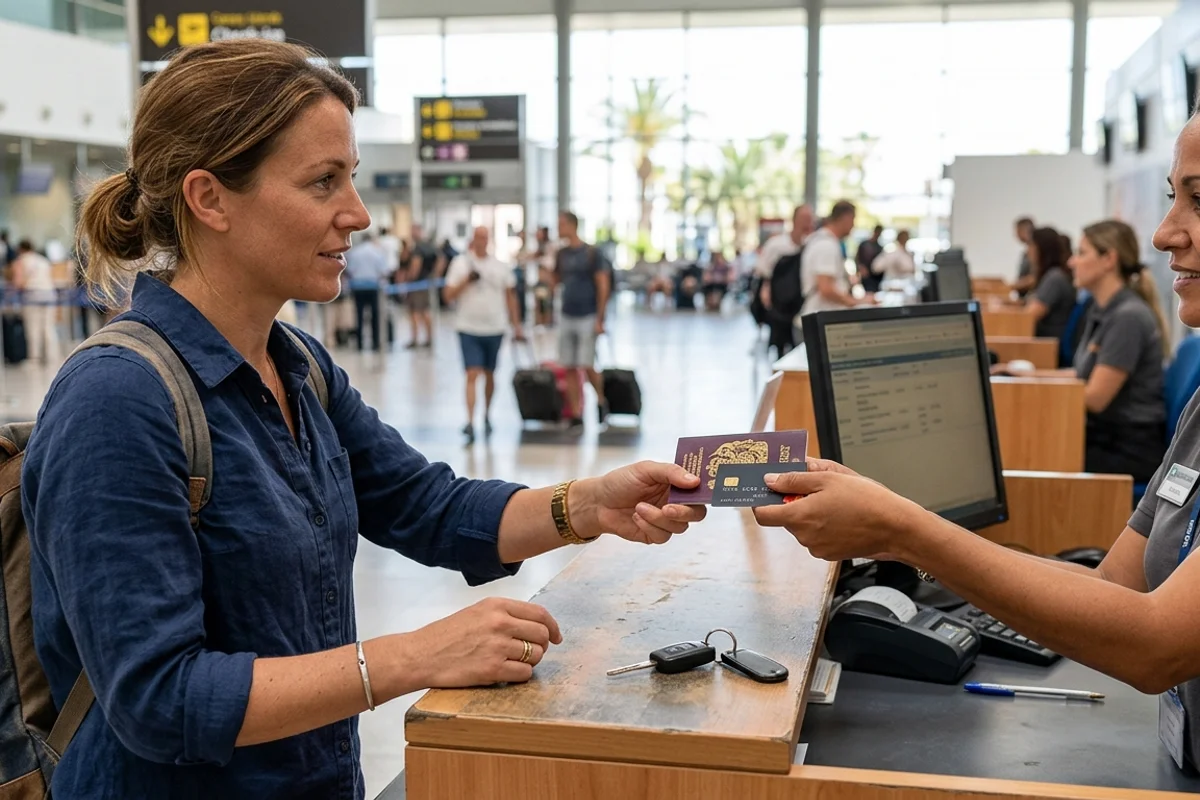
Arriving at the airport after a four-hour flight should be the start of a relaxing break. You collect your luggage, walk up to the rental desk, and hand over your driving licence. Then the agent asks for a credit card to block 1,200 euros. For many holidaymakers, this is an unexpected shock. The funds are instantly frozen by the bank. Your holiday budget suddenly feels very tight before you have even left the terminal building.
Understanding the car hire deposit excess tenerife system is the best way to avoid this stressful start to your trip. This financial mechanism catches thousands of visitors off guard every year. This guide breaks down exactly what these charges mean on the island, how much you can expect to pay in 2026, and the practical steps you can take to remove these massive blocks entirely.
Let us start by separating the two concepts. The terms are often used interchangeably at the rental desk by both customers and staff. They are heavily linked, but they mean completely different things in practice.
The excess is your financial liability. It is the absolute maximum amount you will pay if the rental vehicle is damaged, stolen, or involved in an accident. Imagine you are driving up the winding TF-21 road towards Mount Teide. Another driver clips your wing mirror and drives off. The replacement cost from the local garage is 300 euros. If your excess is set at 1,000 euros, you must pay that full 300 euro repair bill. If the entire car is written off in a major crash on the TF-1 motorway, you pay exactly 1,000 euros. The rental company’s main insurance policy covers the remaining thousands.
The deposit is the physical security hold placed on your bank account. Rental companies need a solid guarantee that you actually have the funds available to pay the excess if a crash happens. They block this money on your card before they hand over the keys. This hold also covers secondary issues. If you return the car with an empty fuel tank, lose the physical electronic key, or acquire speeding fines, the company uses the deposit to cover those costs.
A deposit is processed as a pre-authorization. This means the money never actually leaves your bank account. It is simply ring-fenced. You cannot spend it on restaurant meals in Costa Adeje or tickets to Siam Park. It reduces your available credit limit for the duration of your holiday.
The Canary Islands present a unique set of driving challenges. The main coastal motorways like the TF-1 in the south and the TF-5 in the north are modern, smooth, and spacious. The rural routes are another story entirely.
The famous TF-436 road down to the remote village of Masca is a prime example of island driving. It features sharp hairpin bends, sheer cliff drops, and incredibly narrow passes where two cars can barely squeeze past each other. Scratched paintwork and dented bumpers are incredibly common on these tourist routes. The TF-12 through the Anaga Rural Park often suffers from low cloud and mist, making the twisting asphalt slippery and reducing visibility to just a few metres.
Parking is another major factor contributing to vehicle damage. Towns like Puerto de la Cruz, Garachico, and the capital Santa Cruz were built long before the invention of the modern SUV. Underground car parks often feature tight concrete pillars and extremely narrow bays. Door dings happen daily in these crowded spaces. Rental companies hold large deposits because minor cosmetic damage is a frequent, unavoidable reality of driving on this volcanic island.
Prices vary depending on the exact vehicle category you choose. Smaller, cheaper cars carry lower financial risks for the supplier. Larger or premium vehicles require a heavier financial commitment from the driver. Below is a realistic look at what you can expect to see on your rental contract this year.
| Car Category | Typical Excess Liability (EUR) | Typical Deposit Hold (EUR) |
|---|---|---|
| Mini / Small Economy (e.g., Fiat 500) | 800-1,000 | 900-1,100 |
| Compact (e.g., VW Golf) | 1,000-1,200 | 1,100-1,300 |
| Mid-size SUV (e.g., Nissan Qashqai) | 1,200-1,500 | 1,300-1,600 |
| People Carrier / 7-Seater | 1,500-1,800 | 1,600-2,000 |
If you are planning a special trip and want to drive something spectacular along the coast, you should view our luxury vehicles. High-end sports cars and premium convertibles naturally command much higher excess limits due to their replacement value. A premium German SUV might require an excess and a corresponding deposit of 2,500 euros or more.
You do not have to accept a massive block on your credit card. There are two primary ways to protect yourself financially and reduce your liability to zero. Both methods involve paying for extra insurance, but they work in completely different ways at the rental desk.
The simplest method is buying the rental company’s own top-tier insurance. This is usually called Super Collision Damage Waiver (SCDW), Premium Cover, or Zero Excess Insurance. You pay a daily fee on top of your base rental rate. In 2026, this typically costs between 15 and 25 euros per day for a standard economy car.
When you buy this cover directly from the desk agent, your excess drops to zero. If you scratch the bumper on a low wall in Los Cristianos, you pay nothing. Because your liability is now zero, the rental company no longer needs to hold a massive deposit. They will usually only block a small, nominal amount. This is often between 50 and 100 euros, simply to cover missing fuel if you fail to fill the tank before returning the car.
The second method is buying an independent excess reimbursement policy. You purchase this online from a third-party insurance broker before you travel. These policies are highly cost-effective, often costing around 5 to 8 euros per day.
However, the mechanics of this policy are entirely different. With an independent policy, the rental company in Tenerife still blocks the full deposit of 1,000 euros or more on your credit card. They do not recognize third-party policies at the desk. If you damage the vehicle, the rental desk will charge you for the repairs out of that blocked deposit. You must then take the repair invoice, the local police report, and your final rental agreement, and claim the money back from your independent insurer when you return home.
This option saves you money on the daily rate, but you must have a credit card with a large enough limit to absorb the initial deposit block.
Payment methods cause more arguments at airport rental desks than any other issue. To leave a standard deposit, you must present a physical credit card in the name of the main driver. The numbers must usually be embossed, and the card must have sufficient available credit to cover the full deposit amount.
Debit cards are highly problematic for security deposits. The international banking system treats debit holds differently from credit pre-authorizations. Many rental companies simply refuse them for large security blocks because releasing the funds back to a checking account is a messy, unreliable process. If you arrive at the desk with only a Visa Debit or Mastercard Debit, the agent will almost certainly force you to buy their premium zero-excess insurance. This bypasses the need for the large deposit, allowing them to accept the debit card for the base rental cost and the minor fuel hold.
Always check your credit card limit a week before you fly. If your total limit is 1,500 euros, and the desk blocks 1,200 euros, you only have 300 euros left to spend during your holiday. Request a limit increase from your bank early if you plan to rely on a single card.
You must read the small print of your rental agreement carefully. The basic Collision Damage Waiver (CDW) included in most European car rentals has strict exclusions. It usually covers the main painted bodywork of the car. It almost never covers the tyres, the glass, the undercarriage, or the roof.
This is highly relevant for driving in Tenerife. If you drive into the Teide National Park, you will encounter sharp volcanic gravel on the road edges. Loose stones frequently flick up from passing coaches and crack windscreens. If you get a flat tyre on the TF-5 motorway and need a replacement, the standard excess will not help you. You will pay the full cost of the tyre out of your own pocket. Upgrading to a premium zero-excess policy usually adds vital protection for both glass and tyres.
When your holiday ends, you drive the vehicle back to the designated return area at the airport. An inspector will walk around the car checking for new scratches, dents, or interior damage. They will also look at the dashboard to ensure the fuel gauge matches the agreed return level.
If the car is in perfect condition, the agent authorizes the release of your deposit on their handheld terminal. The money does not instantly appear back in your available balance. Spanish banking systems take time to process these international releases. It generally takes between 3 and 15 working days for the pending transaction to vanish from your credit card statement. Do not panic if the funds are still blocked when you land back in your home country.
You can protect yourself from false claims by taking clear, date-stamped photographs of the car when you collect it. Photograph every single panel, the alloy wheels, and the interior seats. Take a clear picture of the fuel gauge and the exact mileage. Repeat this exact process when you drop the car off before your flight. If a dispute arises two weeks later about a scratch on the passenger door, your photographic evidence is your primary defence.
In 2026, a standard economy or compact car requires a deposit between 800 and 1,200 euros. Mid-size SUVs and family estates usually demand between 1,200 and 1,500 euros. Premium and luxury vehicles start at 2,000 euros and scale upwards based on the value of the car.
Yes, but it comes with strict financial conditions. You will almost certainly have to purchase the rental provider’s maximum insurance package at the desk. This reduces the required deposit to a nominal fuel hold of around 50 to 100 euros, which can then be charged to a standard debit card.
Third-party liability is a strict legal requirement in Spain and is automatically included in your base rental price. This covers damage to other people, their vehicles, and public property. Your excess and your zero-excess upgrades only apply to the physical damage sustained by your specific rental vehicle.
If you have a standard excess of 1,000 euros, you are liable for the repair costs up to that amount, even if you were nowhere near the car when the damage occurred. Hit-and-run damage in a public car park is treated exactly the same as an at-fault accident. This is why many visitors prefer to upgrade their insurance for peace of mind.
The rental company releases the block immediately upon a clean vehicle inspection at drop-off. However, your own bank dictates when the funds actually become available again. Expect a standard delay of 3 to 15 working days depending on your credit card provider and your home country.
Navigating the complex rules of deposits and insurance does not have to ruin your holiday planning. By understanding your options in advance, you can choose the exact level of financial risk you are comfortable with. When you are ready to secure your vehicle, explore our options for car rental Tenerife. We offer transparent pricing with no hidden surprises. You can collect your keys directly at Tenerife South Airport and start exploring the island’s incredible landscapes immediately.
 Anna Müller

 Oliver Thompson


 Sophie Dubois
 Carlos Ramirez
 Carlos Ramirez
 Oliver Thompson
If the return time is later than the pickup time, 1 day will be added to the rental cost. Make pickup and return time the same.
 Isabella Rossi
 Luca Bianchi