El Caleton Natural Pools: A Refreshing Escape into Pristine Wilderness
 Isabella Rossi
6 min read
 Luca Bianchi
Ready to rent a car in Tenerife?
Most visitors associate the Canary Islands with dry, sun-baked landscapes and massive beach resorts. North Tenerife offers a completely different reality. When you drive past the capital city of Santa Cruz and head towards the northern coast, the terrain changes dramatically. The arid scrubland gives way to dense pine forests, deep green ravines, and banana plantations terraced into steep volcanic slopes.
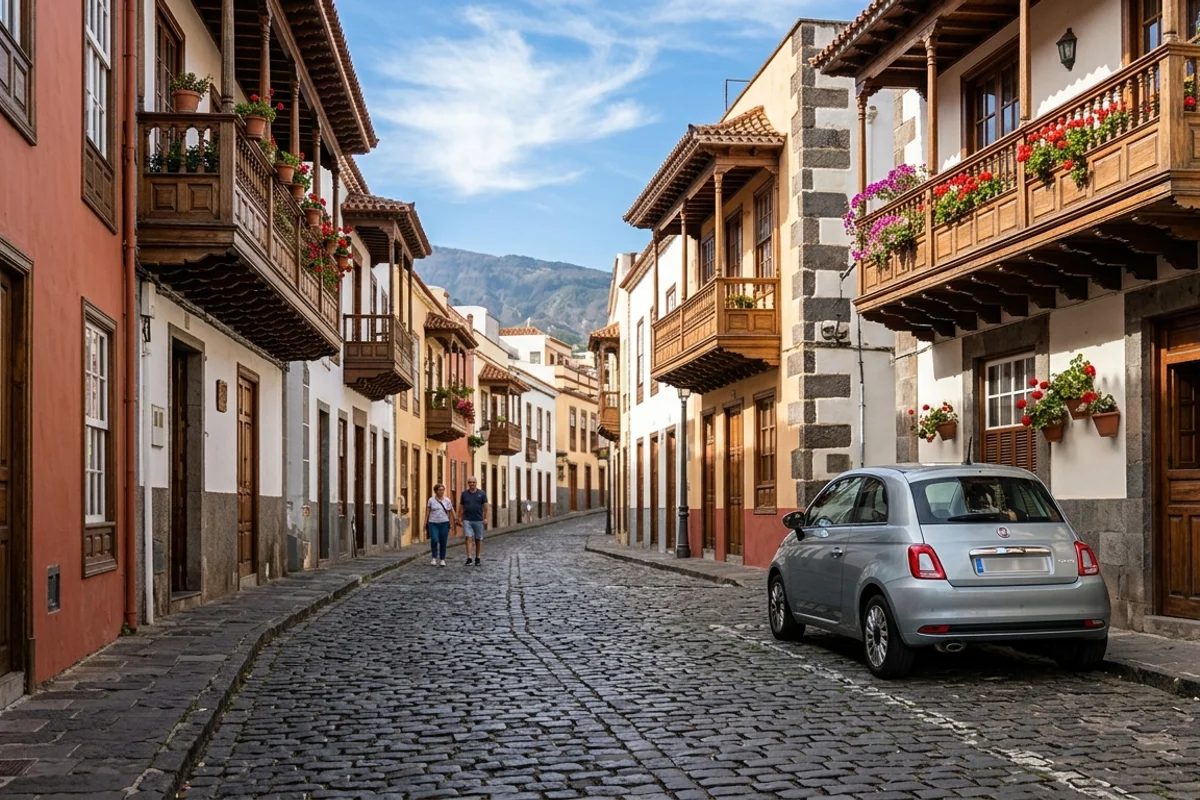
You will find historic towns with cobblestone streets that have remained largely unchanged for centuries. The air is cooler here, often carrying a distinct moisture from the trade winds that water the local flora. Having your own vehicle is essential if you want to see these remote areas on your own schedule. Public buses, while reliable, simply do not reach many of the hidden trailheads, isolated black sand beaches, or family-run rural restaurants that make this side of the island so compelling.
Your journey almost certainly begins in the south. The vast majority of international flights land at Tenerife South Airport (TFS). This airport handles the bulk of the island’s tourist traffic and provides the easiest point to pick up a vehicle. Once you have your keys, the drive to the north is straightforward but requires some time.
You will take the TF-1 motorway heading north-east along the coast. This road is modern, well-maintained, and typically flows freely outside of peak commuter hours. After about 45 minutes, the TF-1 connects with the TF-5 near Santa Cruz de Tenerife. The TF-5 is the main artery of the north, sweeping along the coastline and connecting the major northern towns like La Laguna, Tacoronte, and Puerto de la Cruz.
Traffic on the TF-5 can be heavy, particularly in the mornings between 7:00 am and 9:00 am as locals commute towards the capital. Planning your drive outside these windows will save you a frustrating delay near the Los Rodeos area.
Selecting the right vehicle makes a significant difference on northern roads. The highways are wide and smooth, but the moment you turn off towards a mountain village, the streets narrow drastically. Sharp bends, steep inclines, and tight parking spaces are the norm in places like Icod de los Vinos or the Anaga mountains.
A compact car is usually the best choice for a couple or a small family. Smaller vehicles are much easier to manoeuvre through historical town centres where the roads were built for horse-drawn carts rather than modern traffic. If you plan to spend most of your time on the coast and want to enjoy the spectacular ocean views, you might consider booking a luxury car or a convertible to make the most of the sunny coastal stretches.
Manual transmissions are still very common and often cheaper, but an automatic can be a blessing on steep hill starts. Make sure to check your tyres before leaving the lot. The northern roads are frequently damp from low-hanging clouds, and good tread is vital for safe braking on winding descents. Finding the best car rental Tenerife has to offer means looking for a provider that guarantees well-serviced vehicles suitable for mountain driving.
To help you plan your daily itineraries, here is a practical guide to driving times between key locations in the north. These estimates assume normal traffic conditions on a weekday.
| Route | Main Roads Used | Distance | Estimated Drive Time |
|---|---|---|---|
| Santa Cruz to Puerto de la Cruz | TF-5 | 38 kilometres | 35-45 minutes |
| Puerto de la Cruz to Garachico | TF-5, TF-42 | 28 kilometres | 40-50 minutes |
| La Laguna to Anaga (Cruz del Carmen) | TF-12 | 11 kilometres | 25-30 minutes |
| Garachico to Punta de Teno | TF-42, TF-445 | 16 kilometres | 30-40 minutes |
| Puerto de la Cruz to Teide Cable Car | TF-21 | 42 kilometres | 70-85 minutes |
The Anaga massif occupies the extreme north-eastern tip of Tenerife. This mountainous region is covered by a dense canopy of laurisilva, a type of subtropical forest that dates back to the Tertiary period. Driving the TF-12 road through Anaga feels like entering a different era. The road twists endlessly along the mountain ridges, offering sudden drops and spectacular views of both the northern and southern coastlines.
Take the turn-off onto the TF-134 to descend towards Taganana and the wild beaches of Benijo and Almáciga. This descent is steep and requires heavy use of lower gears to avoid burning out your brakes. The black sand beaches at the bottom are striking, with massive jagged rocks protruding from the surf. Parking at Benijo is limited to a dirt strip alongside the road, so arriving before 10:00 am is highly recommended to secure a space.
Often referred to simply as La Laguna, this was the original capital of Tenerife. The historical centre is a UNESCO World Heritage site, laid out in a grid pattern that later served as a model for colonial cities in the Americas. The streets are lined with brightly painted mansions featuring ornate wooden doors and stone courtyards.
The centre itself is fully pedestrianised. You will need to park your car on the outskirts. The underground parking facility at Plaza del Adelantado is highly convenient and charges around 1.80 euros per hour in 2026. From there, you can easily walk to the Cathedral and the bustling Calle Obispo Rey Redondo.
Situated in the lush Orotava Valley, this town is famous for its aristocratic architecture. The Casa de los Balcones is the main attraction, showcasing massive, intricately carved wooden balconies. The streets here are incredibly steep. Driving up them requires confidence and a firm grasp of clutch control if you are driving a manual vehicle.
Street parking in La Orotava is notoriously difficult to find. Look for the municipal parking lot near the Plaza de la Constitución. After exploring the town, you can drive up the TF-21 road directly from La Orotava into the Teide National Park, watching the pine forests slowly give way to volcanic rock as you climb above the cloud line.
This is the main tourist hub of the north, but it retains a distinct local character. The town surrounds a working fishing port where you can still watch locals bringing in their daily catch. The Lago Martiánez, designed by artist César Manrique, is a massive complex of saltwater pools integrated into the volcanic rock of the coastline.
Finding free parking in Puerto de la Cruz can be a challenge. The large dirt esplanade near the harbour offers free parking, but it fills up very quickly on weekends. Alternatively, there are several paid parking garages near the Martianez shopping centre that charge roughly 15-18 euros for a full 24-hour period.
In 1706, a volcanic eruption destroyed Garachico’s harbour, which was then the most important port on the island. The lava flowed directly through the town and into the sea. Today, that solidified lava forms the natural swimming pools of El Caletón. The town itself was beautifully rebuilt and features peaceful plazas and a well-preserved castle, the Castillo de San Miguel.
The drive to Garachico along the TF-42 is relatively flat and hugs the coastline closely. You will pass through several small banana-farming villages. There is a large municipal parking area right on the waterfront near the football pitch, which is usually free of charge and provides easy access to the historical centre.
You cannot drive through north Tenerife without stopping at a guachinche. These are traditional, rustic establishments where local wine producers sell their own wine accompanied by a limited menu of home-cooked Canarian food. They are predominantly found in the northern municipalities of Tacoronte, El Sauzal, La Matanza, and La Orotava.
Guachinches are often located in garages, covered patios, or agricultural outbuildings. They are rarely heavily advertised, so you will need to keep an eye out for small cardboard signs nailed to trees or telephone poles along the rural roads (usually the TF-217 or TF-152).
A typical meal includes dishes like garbanzas (chickpea stew), carne fiesta (marinated pork), and papas arrugadas (wrinkly potatoes) served with red and green mojo sauces. In 2026, a hearty meal for two people, including a jug of house wine, typically costs between 22 and 30 euros in total. Most genuine guachinches do not accept card payments, so you must carry cash.
The weather in the north is highly unpredictable due to the phenomenon known as the sea of clouds (mar de nubes). The trade winds push moist air against the northern mountain slopes, creating a thick layer of fog and drizzle, locally called bruma. You can start your drive in brilliant sunshine in Puerto de la Cruz, and ten minutes later find yourself in thick fog as you drive up towards La Orotava.
Always use your dipped headlights when entering these cloud layers. The fog can reduce visibility to less than 20 metres in extreme cases. Reduce your speed, keep a safe distance from the car in front, and never use your high beams, as the water droplets in the air will simply reflect the light back at you and worsen your visibility.
Petrol stations are plentiful along the TF-5 motorway. However, if you are heading up into the Anaga mountains or the Teno Rural Park, you must fill your tank beforehand. There are absolutely no fuel stations in these protected natural areas. In 2026, the price of unleaded 95 petrol hovers around 1.35 to 1.45 euros per litre, which remains significantly cheaper than in mainland Europe.
The main motorways and coastal roads are wide and easy to navigate. The difficulty arises in the mountain regions like Anaga and Teno, where roads are narrow, winding, and feature steep gradients. Drivers should be comfortable reversing in tight spaces to let oncoming buses or trucks pass.
No. All the major viewpoints, towns, and trailheads are accessible via fully paved roads. A standard compact car is actually preferable to a large SUV, as smaller vehicles are much easier to park and manoeuvre through the narrow streets of historical towns.
There are no toll roads anywhere in the Canary Islands. All motorways, including the TF-1 and TF-5, are completely free to use.
Pay attention to the painted lines on the road. White lines mean parking is free and unrestricted. Blue lines indicate a paid zone where you must buy a ticket from a nearby machine (usually active during commercial hours, Monday to Saturday morning). Yellow lines mean parking is strictly prohibited.
Pull over to a safe spot as soon as possible and put on your high-visibility vest before exiting the vehicle. Place your warning triangles on the road. Call the roadside assistance number provided on your rental agreement. Coverage maps for mobile phones are generally excellent across Tenerife, though you may find brief dead zones deep in the Anaga ravines.
The green valleys and historic towns of the north offer a driving experience unlike anywhere else in the Canary Islands. To start planning your route, secure your vehicle early, especially if you are travelling during the busy winter season. Head over to our main page to book your car and arrange a seamless pickup directly at the airport.
 Isabella Rossi

 Oliver Thompson
 Camila Fernández
 Isabella Rossi
 Mia Andersen

 James O’Connor
If the return time is later than the pickup time, 1 day will be added to the rental cost. Make pickup and return time the same.
 Thomas Schneider
 Carlos Ramirez