El Caleton Natural Pools: A Refreshing Escape into Pristine Wilderness
 Isabella Rossi
6 min read
Isabella Rossi
Ready to rent a car in Tenerife?
Hiring an electric vehicle on a volcanic island brings up a few practical questions. You want to know if a battery-powered car can handle the steep climb to Mount Teide. You need to know where the charging points actually are. Most importantly, you want to find out if electric car hire tenerife is a smart choice for your holiday or a fast track to range anxiety. Let us look at the facts.
The Canary Islands have invested heavily in green infrastructure. The charging network is vastly better today than it was even two years ago. However, driving an EV here requires a slightly different mindset compared to driving in a flat urban city. The landscape dictates how you drive and how you charge.
Tenerife is a massive volcano rising 3718 metres out of the Atlantic Ocean. This geography plays a huge role in how an electric car performs. If you drive from the coast up the winding TF-21 road into the Teide National Park, your dashboard range will drop incredibly fast. A climb from sea level to 2300 metres requires serious energy. It is completely normal to see your predicted range halve during this ascent.
Do not panic when you see the battery percentage plummet on the way up. The magic of driving an EV here happens on the descent. Thanks to regenerative braking, driving back down towards the coast will actively recharge your battery. It is entirely possible to reach the bottom with more range than you had at the summit.
The steep gradients do mean you cannot rely strictly on the official manufacturer range. If you hire a standard electric hatchback with a stated range of 350 kilometres, expect to get around 250 kilometres in real-world Tenerife driving. This is still plenty for a day of exploring, but it requires a bit of planning before you set off into the mountains.
Another massive advantage of driving an EV in Tenerife is the climate. Electric batteries drain quickly in freezing winter temperatures. Because Tenerife enjoys year-round warmth, your battery will operate at peak efficiency. You will not lose 20 percent of your range just because it is cold outside.
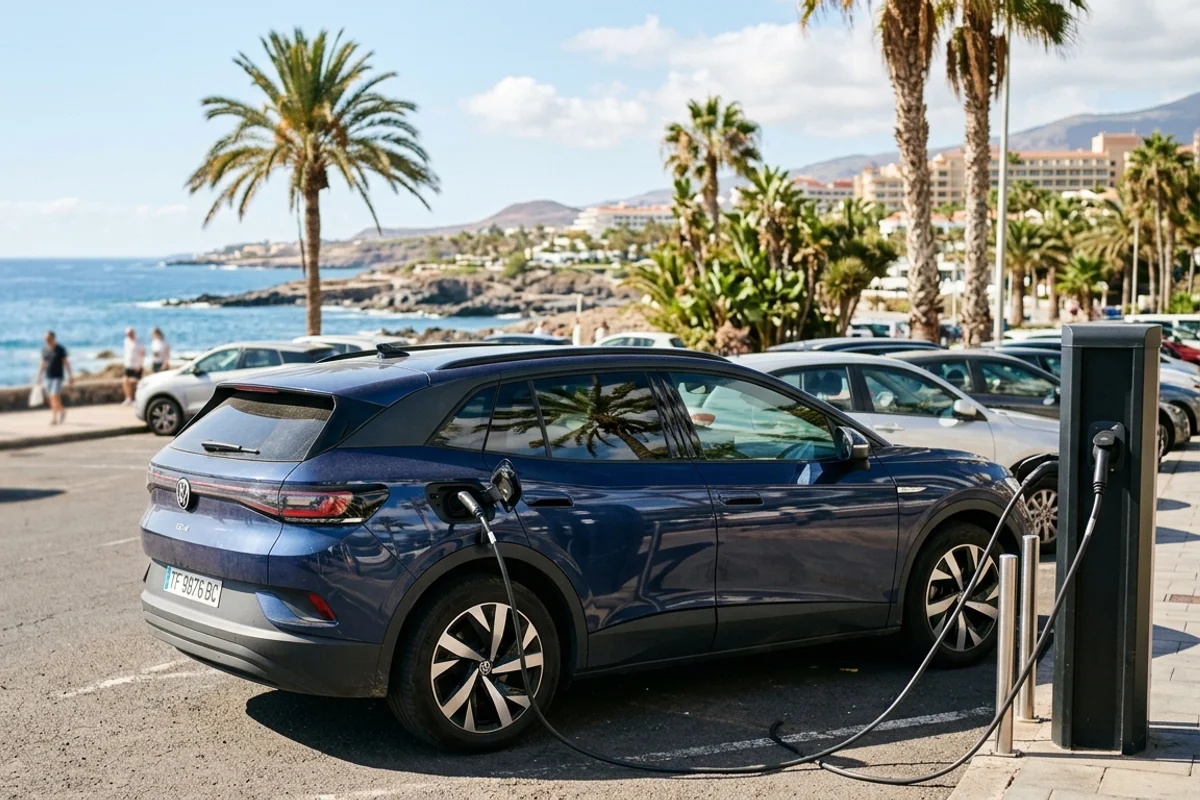
You will no longer struggle to find a plug on the island. You do need the right apps on your phone to make the process smooth. Electromaps is the most widely used app across Spain. It shows almost every public charger on the island, user reviews, and whether the plug is currently working. Endesa X Way and Iberdrola are the main network providers operating the actual machines.
Fast chargers are conveniently located along the main TF-1 motorway. This road runs down the east and south coasts. You will find reliable 50kW and 150kW stations near major shopping centres. Siam Mall in Costa Adeje and Centro Comercial Añaza near Santa Cruz are excellent spots to top up. Charging at these faster points usually costs between 0.40 euros and 0.60 euros per kWh.
Many hotels now offer destination charging for guests. This is the ultimate convenience for any holiday. You plug in overnight and wake up to a full battery. Always email your hotel before booking to confirm they have working EV points. Some older resorts still lack the infrastructure. Supermarkets like Mercadona and Lidl also offer cheap slow charging while you shop, though these are typically capped at 11kW or 22kW.
If you are travelling to the rugged north, the infrastructure is slightly less dense but still perfectly adequate. Towns like Puerto de la Cruz and La Orotava have municipal charging points in their main underground car parks. You can leave the car on charge while you enjoy a long lunch by the sea.
If you feel nervous about relying entirely on battery power, a hybrid vehicle offers a superb middle ground. Standard self-charging hybrids are incredibly popular choices for car hire Tenerife. They use regenerative braking to charge a small battery, which then assists the petrol engine. This setup is brilliant for the stop-start traffic around Los Cristianos and helps lower your fuel consumption on the winding roads of the Anaga Rural Park.
Plug-in hybrids give you the ability to drive 40-60 kilometres on pure electricity. You can do your daily coastal trips to the beach without using a drop of petrol. When you want to take a longer drive to the north of the island, the petrol engine kicks in automatically.
Fully electric vehicles are quieter, smoother, and cheaper to run if you have access to destination charging. They also give you preferential parking in some municipalities. The choice depends entirely on your itinerary. If you plan to drive 200 kilometres every single day exploring every corner of the island, a hybrid might offer more peace of mind. If you are doing shorter trips and have a charger at your villa, full electric is a fantastic option.
Most international visitors arrive via the south of the island. When you book your vehicle for collection at Tenerife South Airport (TFS), the process is exactly the same as hiring a traditional petrol car. The rental desk will hand over the keys and a charging cable. Always check the boot to ensure the heavy Type 2 cable is present before you drive away.
The car should have a battery level of at least 80 percent upon collection. This is more than enough to get you to any resort on the island. A drive from the airport to Costa Adeje takes about 15 minutes on the TF-1 and uses barely any battery. Even if you are heading all the way to Puerto de la Cruz in the north, the 90-kilometre motorway journey will only use a fraction of your charge.
Take five minutes to familiarise yourself with the car before leaving the airport parking lot. Electric cars often have different starting sequences and gear selectors. Make sure you know how to open the charging port flap and how to read the estimated range on the dashboard display.
Let us look at the financial side of your transport. The initial daily rate for an electric car is often slightly higher than a basic petrol model. The running costs can balance this out quickly. Petrol prices in the Canary Islands are lower than mainland Europe, sitting around 1.35 euros per litre in 2026. However, electricity can be even cheaper if you charge smartly.
Here is a realistic breakdown of average costs for a seven-day rental during the mid-season. These figures assume you drive roughly 500 kilometres during your week.
| Vehicle Category | Estimated 7-Day Rate (Euros) | Fuel/Charge Cost per 500km | Total Estimated Cost |
|---|---|---|---|
| Economy Petrol (e.g. VW Polo) | 180 | 45 | 225 |
| Standard Hybrid (e.g. Toyota Yaris) | 210 | 35 | 245 |
| Compact EV (e.g. Peugeot e-208) | 240 | 25 | 265 |
| Premium EV (e.g. Tesla Model 3) | 450 | 30 | 480 |
The total cost difference between petrol and electric is surprisingly small. The EV will cost slightly more overall, but you get a vastly superior driving experience. Electric motors provide instant torque. This makes them incredibly fun and responsive to drive on the twisting mountain roads.
Taking an electric car up the TF-436 to the famous village of Masca is a brilliant experience. The silence of the electric motor lets you actually hear the wind and the birds as you navigate the hairpin bends. You do not have an engine screaming in first gear as you climb the steep sections.
If you want to upgrade your holiday experience, you should definitely explore luxury car rental. High-end electric vehicles from brands like Porsche, BMW, and Tesla are readily available in Tenerife. These premium cars offer massive batteries with real-world ranges easily exceeding 400 kilometres.
With a long-range luxury EV, you can drive from the south coast, up through the Teide National Park, down into the Orotava Valley, and back again without needing to stop for a charge. These vehicles also feature advanced navigation systems that automatically route you via fast chargers if your battery does run low, taking all the guesswork out of your journey.
Driving in Tenerife is generally very safe and straightforward. The TF-1 motorway wraps around the south and east, while the TF-5 covers the north. These dual carriageways are well maintained and easy to navigate. Best of all, there are no toll roads anywhere on the island.
Speed limits are strictly enforced by radar cameras and unmarked police cars. The maximum limit on the motorways is 120 km/h. This frequently drops to 100 km/h or 80 km/h near junctions, sharp bends, and tunnels. Pay close attention to the overhead road signs.
Always give way to traffic already on a roundabout. This sounds obvious to most European drivers, but the local driving style on roundabouts can be a bit chaotic. Drivers in the outside lane often go all the way around, crossing past the exits. Stay alert and use your mirrors constantly.
If you are planning to arrange car rental in Tenerife during the peak winter months of December to February, book your vehicle well in advance. Electric and hybrid models are highly sought after by winter sunseekers and fleets sell out weeks ahead of time.
Rental companies usually ask you to return the car with the same battery level it had at pick-up. If you received it at 80 percent, aim to bring it back around that mark. Some companies offer a pre-paid charging option when you book. This allows you to return the vehicle completely empty without facing penalty fees.
There are no public fast charging stations inside the national park itself. The Parador hotel has slow charging facilities for overnight guests, but day-trippers should ensure they have enough charge before leaving the coast. Charge up in Vilaflor or La Orotava before you start the main ascent.
This depends entirely on the charger you use. A 50kW fast charger will take a standard EV from 20 percent to 80 percent in about 45 minutes. A slow 11kW destination charger at a hotel will take 6-8 hours to fill an empty battery. Plan to use slow chargers overnight and fast chargers during quick lunch stops.
Not at all. Hybrids and EVs are all automatic and actually much easier to drive in the mountains than manual cars. You never have to worry about clutch control on steep hill starts. The instant power delivery makes overtaking slow coaches on mountain passes very safe and easy.
If you completely drain the battery, the car will stop, just like a petrol car running out of fuel. You will need to call the roadside assistance number provided by your rental company. They will send a tow truck to take you to the nearest charging station. Modern EVs give you plenty of loud warnings long before this happens.
Yes. You will find a Type 2 cable in the boot for using public AC chargers. Some companies also include a standard 3-pin domestic plug cable for emergencies. Fast DC chargers have their own thick tethered cables permanently attached to the machine, so you do not need to use your own cable for those.
Renting an electric or hybrid vehicle on this beautiful island is a brilliant way to travel. The infrastructure is ready, the mountain roads are a joy to drive with instant electric torque, and the quiet operation suits the stunning volcanic landscapes perfectly. If you plan your routes and secure a hotel with charging facilities, you will have a flawless holiday. Ready to book your zero-emission island transport? Check out our live availability and secure your vehicle today for pickup at the airport or other convenient locations across the island.
 Isabella Rossi
 Mia Andersen


 Luca Bianchi
 Carlos Ramirez
 Camila Fernández

If the return time is later than the pickup time, 1 day will be added to the rental cost. Make pickup and return time the same.
 Oliver Thompson
 Sophie Dubois